Wednesday, April 01, 2009

All Crossed Up

Michael Horton
Touchstone Magazine

On the Ordinary Ministry That Can’t Corner the Market

Never mind Paul’s exhortation to Timothy to submit to elders and pastors as official ambassadors of Christ. These days, even in more confessional denominations, it seems that instead of being the Lord’s servant, ambassador, and minister of reconciliation, a pastor is supposed to be the community’s quarterback, class president, or the one voted “most likely to succeed.”

It used to be that the pastor had an office and worked in his study, but today the pastor has a job and works in his office. Whereas Peter organized the diaconal office so that the apostles could devote themselves to the Word and to prayer, ideal ministers seem increasingly to be managers, therapists, entertainers, and entrepreneurial businesspeople.

Open up the average issue of Christianity Today to advertisements for pastoral positions and you’ll find descriptions like “team builder,” “warm and personal style,” “outgoing,” “contagious personality,” and “effective communicator.” (Catholic friends tell me that something like this affects Catholicism, too.)

I think they’re looking for a Director of Sales and Marketing, whom they may (or may not) call “Pastor.” I’m not against directors of sales and marketing; I just don’t think that this is what we should be looking for in the way of shepherds.

Habits of the Pastoral Heart

We wouldn’t have had Paul, for example. Who, having advertised for an outgoing team builder with a contagious personality, would have hired a pastor who openly disclosed the fact that he was not a great communicator, suffered everywhere he was sent, was nearly blind, and lacked the natural charisma of the “super-apostles,” who were only too happy to point out these weaknesses themselves?

Perhaps, like the immature and sectarian Corinthians (1 Cor. 3:5–9), we celebrate the extraordinary minister more than the ordinary ministry of the gospel.

The different approaches to church life, worship, and outreach more generally express different ministry values, which might be summarized this way:

Ordinary < > Extraordinary
Communal < > Individualistic
Predictable and Disciplined < > Spontaneous and “Authentic”
Respectful of office < > Respectful of persons
Hierarchical < > Egalitarian
Patient < > Restless
Receptive < > Expressive
Mediated < > Immediate
Wise/Knowledgeable < > Practical/Intuitive
Custodial/Pastoral < > Entrepreneurial
Formal < > Casual
Mature < > Creative
Traditional < > Innovative
Deferential < > Independent

I am not suggesting that these contrasting tendencies should be simplistically identified with “good” and “bad” respectively. Although for a couple of decades now I have been a parishioner and minister in confessional Reformed churches that favor the left side of the chart, I was reared in churches that tilted toward the right side.

I am suggesting that many pastors and churches (including, again, mainline Protestants and Catholics) seem to assume that the first side represents dead traditionalism and the right side yields genuine vitality. For example, a “worship experience” is only “real” when it’s “authentic.” This oft-heard tautology means that it provides an opportunity for me to experience and express my unmediated, extraordinary, intuitive, deeply personal, individual, and spontaneous familiarity with God.

Churches and pastors whose values fall more on the left side concentrate on the ordinary means of grace. They emphasize a predictable, ordered, and disciplined approach to corporate and personal growth through formal practices of preaching, sacrament, catechesis, profession of faith, training and ordination of ministers, and caring for the flock from cradle to grave.

These values are likely to generate a concern for careful study, deliberate decisions about worship and church life, and a more “covenantal” approach that sees the local church as a local expression of the catholic church. Since, in theological terms, this approach maintains that God keeps covenant through the generations, it is more likely to foster inter-generational community.

As a minister in a largely Dutch-immigrant denomination, I have been impressed with the countercultural community exhibited by a pew filled with three generations. In an age of niche demographics and target-marketing even in church, this has been refreshing.

Of course, these values, too, can mask a lazy and unreflective piety that contents itself with its familiar practices and parishioners, that is turned inward with little sense of its commission to the world. In both cases, I wonder whether we reflect enough on the extent to which ministry is often captive to cultural sensibilities that are mistaken for biblical piety.

As I read the Scriptures, it seems that the values most often commended favor the left side of the ledger. Yet in my experience at least, Evangelicals tend to question the authenticity of Christian experience (individually or corporately) unless it is expressed in terms of an immediate, deeply personal, individual, inward, spontaneous, and ever-new relationship that can also be discerned in the entrepreneurial, innovative, spontaneous creativity of “worship experiences.”

To what extent are the values on the right side of the ledger simply expressions of an American personality that easily drifts, in the sphere of faith and practice, toward gnosticism?

Although I do not have the space to offer citations, there are many passages that define faithful ministry in terms of preaching, teaching, sacrament, fellowship, and the prayers (as mentioned, for example, in Acts 2:42). There are no passages that tell us to expect, much less to plan, revivals or other extraordinary events to perk up this ordinary ministry.

A Different Orientation

Both traditionalists and anti-traditionalists often reflect a human-centered, merely horizontal orientation. Ministry is focused either on keeping the generations together, closely bound in a fellowship across time, or on outreach.

Both forget that the public ministry of Word and sacrament is first and foremost a vertical, eschatological event of the Spirit’s disrupting grace that generates a horizontal extension of covenant succession in history while also drawing in outsiders by that same ministry. It is first of all God’s work, not ours, whether we’re thinking in traditional or innovative categories.

Christ is serving us, building his kingdom, drawing people by his Spirit from the dominion of sin and death, leading them in ever-richer understanding of the gospel, extending that message and acts of love outward to the neighbor. The Triune God is the one creating a new world in the midst of this fading evil age, not simply keeping the old one going or dressing it up in perpetual innovation.

A host of passages exhort believers to patient and mutual submission, progressive maturity and unity in the Word, and a community that is disciplined in its worship, life, and doctrine. There are clear instructions on the examination and ordination of a formal ministry that is entrusted with authority subordinate to Christ, with commands to “guard what has been entrusted to you,” going on from the milk of the Word to solid food, and so forth. There are no equivalent injunctions or instructions for small groups, para-church ministries, crusades, marches, revivals, or other movements that celebrate the extraordinary, spontaneous, restless, expressive immediacy that Americans relish, whether in church or on daytime talk shows.

Just as traditionalism is a parody of a living tradition, a ministry defined by the entrepreneurial, creative, and innovative capacities of today’s “super-apostles” should not be mistaken for genuine growth and outreach. Marking the remarkable missionary advances of the apostles, we meet repeatedly in the Book of Acts the phrase, “the word of God spread.”

Mission was about Christ as he is delivered to sinners through the gospel, not about us and our frantic efforts to make a sale. In fact, that is the last clause in Peter’s invitation: “The promise is for you and your children, and for those who are far off, as many as the Lord our God will call to himself .” The church is not called to mimic the world, but to feed the world the Bread of Life and incorporate strangers and aliens into the story of his redeeming work.

God’s Living Word

In his critique of revivalism, the nineteenth-century Reformed minister and professor John Williamson Nevin observed that when he succumbed in his younger years to the pressures of a revival in his town, he was expected to undergo a radical conversion.

In effect, he had to renounce the whole system of covenantal nurture that he had received from baptism, catechism, and confirmation. All of this “formal” religion stood in sharp contrast to the “authentic,” spontaneous, informal, and immediate experience of the individual soul with God.

Nevin, targeting Charles Finney’s “new measures,” contrasted the “system of the catechism”—i.e., the faith and practice summarized in the Westminster catechisms—with the “system of the anxious bench.”

Eventually, Proteus grows weary of the burden of his perpetual, restless, spontaneous, and individualistic makeovers—a works-righteousness that refuses to define the believer or the church as a recipient of God’s grace. As Whitney Cross and other historians have documented, the region most deeply affected by Finney’s repeated revivals became known as the “burned-over district.” Is this not the effect of a religion that identifies genuine faith and piety with the right side of the chart above?

When churches abandon the ordinary ministry for extraordinary “excitements sufficient to induce conversion” (Finney’s phrase), eventually the innovations become traditions and the insatiable craving for ever-new experiences of spontaneous expressivism, like a drug addiction, leads eventually to the spiritual equivalent of a heart attack. Tragically, the landscape of American religion is littered with successive waves of “revival” (often patterned on American trends in salesmanship) followed inevitably by periods of spiritual fatigue and skepticism.

There are no easy answers to finding the right balance between caring for the flock already gathered and seeking those who are far off. However, the New Testament does, I believe, lead us to a crucial conclusion: namely, that the same ministry that leads us and our children to Christ, in an ever-deepening communion with him and his body, also reaches strangers, which most of us (as Gentiles) were ourselves. The church in its ever-widening and ever-expanding circumference is always a creation of the Word.

In response to Peter’s sermon at Pentecost, hearers were “cut to the quick,” and asked how they could be saved. Calling them to personal faith in Christ, the apostle nevertheless directed them not to their own individualistic piety but to baptism and communion with the church.

In the same context where the church’s ordinary life is described in terms of preaching, sacrament, fellowship, prayer, and the sharing of resources, “praising God and having favor with all the people,” we read, “And the Lord added daily to the church those who were being saved” (Acts 2:47). Instead of focusing ecclesial faith and practice on marketing Jesus to the “unchurched,” the apostolic pattern was to draw aimless drifters into the covenantal drama already in progress.

To become a Christian was already to begin one’s lifelong journey in the company of pilgrims under the care of the church. Discipleship was defined by churchmanship. Personal faith in Christ was never set over against active membership in the visible body of Christ.

Begin with Paul

When pastors feel the burden of saving people, selling the gospel, or cornering the market through their own cleverness, methods, creativity, or charisma, they eventually burn out. So, too, do the sheep who are submitted to perpetual exhortations to imitate their restless “authenticity.”

According to a recent study of Evangelical ministers, 1,500 pastors leave the ministry each month and 80 percent of seminary graduates leave within five years. This comports with another study that found that 80 percent of the youth who grow up in Evangelical churches drop out by their sophomore year of college.

Charles Finney’s “burned-over district” is growing like a cancer. The challenge before us is to regain our confidence in the ordinary means of grace: “to grow like a tree rather than a forest fire,” as Wendell Berry described our relation to our local environment.

Should we not begin with Paul’s list of qualifications for our pastors rather than the average job description in circulation today, and abide by the habits of disciplined growth that we find in the New Testament rather than the consumer habits of the marketplace?

Who Counts?

By Agnieszka Tennant
Christianity Today

A conversation with Jean Bethke Elshtain

University of Chicago political philosopher and maternal feminist Jean Bethke Elshtain has devoted her academic career to pointing out inextricable ties between politics and ethics. Among her many books are Public Man, Private Woman: Women in Social and Political Thought; Who Are We? Critical Reflections, Hopeful Possibilities; and Just War Against Terror: The Burden of American Power in a Violent World. In 2005–2006, she delivered the prestigious Gifford Lectures in Scotland, following in the footsteps of William James and Hannah Arendt. In them, she considered the topic of what would become Sovereignty: God, State, and Self, published by Basic Books in 2008. Agnieszka Tennant spoke with Elshtain—her former academic advisor in the master's degree program in international relations at the University of Chicago—about questions prompted by the book. This interview is an edited excerpt from their conversation.

In Sovereignty, you observe the following irony: "In our own liberal society at the moment, and in most of the Western democracies in general, we are pursuing a paradoxical project: We are most aware of those with physical and mental disabilities; we want to provide them access. Yet at the same time, our most enthused-about and ideologically fraught projects aim at creating a world with no such persons in it." How did we arrive at the point of convergence of such opposites?

These kinds of opposites have been embedded in the great Western project from the beginning. If you put a premium on certain kinds of developed capacities—let's say, those who can enact projects of freedom, who have achieved a certain level that we recognize as definitively human—and tethered to that you have philosophies that measure us by our capacity to engage in rational operations, then those who can never maximize their capacity and who lack certain capabilities are going to be a huge problem. You can see that in the social contract literature. John Locke doesn't know what to do with idiots and imbeciles, in the tender language of the day. Where do they belong? They can't sign the contract. They're outside of the rationally interacting universe. Once you set that in play, an ongoing devaluation of certain categories of people takes hold.

Because we want to be compassionate and we feel badly about this, we say we've got to make things fairer for these kinds of people. I don't want to negate the importance of those projects for access. But even as those go on, at the present moment we're rapidly aiming for a more and more strenuous norm of perfection, with the promise and the possibilities of eugenics—or positive genetic enhancements, as we're supposed to call it. We can get more people of an ideal type, where we try to tweak off the bad bits of the genome. That's why a number of ethicists from the Netherlands have said that if you're a parent of a child with disabilities in a liberal Western democracy, particularly if they're mental disabilities, you have reason to be worried—precisely because of the devaluation that's placed on such human beings. Think about what it says to an adult with Down syndrome that the society in which she lives aborts 90 percent of Down pregnancies, and that in an ideal world there wouldn't be any like her left. That says something about how she is valued.

Isn't it possible that a certain kind of generosity and other-mindedness is also at work in the tendencies you see as unchecked notions of self-sovereignty? For example, do you distrust proponents of cloning when they tell us that they have the good of humanity in mind? Do you dismiss the claims of various would-be parents who report they decided to have an abortion not only out of concern for their own lives, but also out of concern for what the lives of their offspring would be like?

I think that's a very dangerous tender-heartedness, a misconstrued understanding of where compassion and empathy ought to lie. There's a wonderful discussion in Walker Percy's novel The Thanatos Syndrome of a Catholic priest's experiences in Nazi Germany in the 1930s, where he heard all the arguments put forward already then about how in the name of compassion we had to end the suffering of people with disabilities. "If you were them, you would want us to kill you," was the reasoning. The first Nazi programs to eliminate the "unfit" targeted people with disabilities rather than Jews.

The notion of aborting a Down syndrome pregnancy because of what the child would go through is an argument I'd strenuously resist. It suggests that one has no experience with or knowledge of people with Down syndrome who are brought up in families as participants in their communities. There was a story in The New York Times not long ago about a sister who spent her life with a brother with Down, whose parents were told he was a Mongoloid idiot who'd live to be ten. Well, he is now fifty. In the past, of course, children with Down often didn't live past ten, because they were put in horrible places and ignored.

People who live among us with multiple disabilities overwhelmingly are happy they're alive. If they didn't want to be here, you'd think there would be an unusually high rate of suicide among them, those who can think through that and are physically capable of it. But we don't see that. You can see mutual enrichment that comes from our encounters with them. And yet I think for some people there's a bit of a stigma attached: I'm not as perfect as I hope to be if the child I brought into this world has problems; it's embarrassing. I think some of that still lingers too.

What do you say to the argument that allowing people with disabilities onto this planet places an undue burden on society?

That's the old utilitarian calculation. It's entirely illegitimate because it suggests that the strong and able-bodied have more right to the things of the earth than those who are weak and not able-bodied. If you believe in the moral quality of persons, that's obviously not an argument you can credit. In practice, it's also a very dangerous argument because it's been made historically for warehousing people or euthanizing people. The Nazi programs had prudential utilitarian reasoning as well. Plus I suspect it's the powerful and the strong and the rich who use up more of the world's resources than the weak and the not-so-powerful. It's a matter of asking ourselves: Who do we welcome? Who do we leave out? Are we the kind of community whose members extend themselves in friendship and recognize the moral worth of beings who don't look like us and don't act like us and cannot achieve like us and who will have claims on our care for their entire lives?

Twelve years ago, you adopted the 3-week-old son of your daughter and son-in-law, who live with mental retardation. How did you personally have to negotiate competing sovereignties in that decision? How much control have you had over that situation's origins and your response to it?

If we think of its origins, they lie in our daughter and her then-husband having a child when the advice of everyone was that they probably couldn't handle it. They obviously wanted to do what normal people do. They were both relatively competent, able to keep an apartment and so on, and thought there was no reason why they couldn't raise a child. But it was very clear that they couldn't after a few weeks: The baby wasn't being given assistance and interaction, wasn't being given the attention it needed. It was obvious that the baby had to be somewhere else, and we moved to become Bobby's guardians and then his parents.

As to what there was to negotiate, that was the easy part. If our daughter and son-in-law had really been making a huge effort, it might have been different, but it was clear they just couldn't do it. They experienced primarily relief when the decision was made, and in a way that was a relief to us because it seemed to be a benefit to them as well. Then the complicated part came: rethinking your lives. We hadn't imagined we'd be doing anything like this at our age, renegotiating issues of work, presence, time, money—all the usual stuff that comes into play with parenting. At first I was thinking abstractly: I didn't know how to do this. But when it became a concrete reality, of course my husband and I could. There he is, this beautiful little kid. What are you going to do? Obviously you're going to be a parent. It becomes not so much a series of decisions as reacting to the concrete reality of the situation—the presence of a being who needs time and attention. How do you respond to that? What do you do about it? After he'd been with us for a short time, we couldn't imagine our lives without him. Being available to, or in the presence of, or responding to is very much how we live our lives. The question would be, Are we prepared to respond? Or are we trying to shut this new reality away? Because it seems impossible or overwhelming. There's nothing like a child to remind you that you're not a sovereign self.

The idea of human dignity seems to have taken a beating lately. Harvard psychologist Steven Pinker ridiculed it in his article "The Stupidity of Dignity" in The New Republic. His target was the President's Council on Bioethics report "Human Dignity and Bioethics," to which you contributed.

You're right, there's an assault on the very notion of dignity. Pinker knows, because it came up in the discussion when I was sitting next to him, that human dignity was very much in play for those who wrote the Universal Declaration of Human Rights, given what they took to be assaults on human dignity by the Nazi regimes and the Soviet tyranny. Hitler never defended human dignity; it was about race privilege, about being fierce beasts that go out and devour the weak.

Pinker has taken an antiquated notion of dignity as naming a certain status that sets you apart from others. That's not how people speak of dignity now, and he knows it. If you acknowledge that all human beings have a dignity that must not be assaulted, you're reminded of your common humanity. Human dignity entails a leveling, a moral equality that offends certain sensibilities. If you consider those who have launched assaults on human dignity historically, they've often believed they can only remain lofty if others are a lot lower. But dignity draws us together.

Contemporary Cosmology and the Beginning of the Universe

By William Lane Craig
ReasonableFaith.org

Question:

I recently was told by some physicists whom I had the chance to interview for a paper that the standard big bang model of the universe does not include a singularity anymore. That may have been the case twenty five years ago, they said, but nowadays physicists say that the big bang extends only back to Planck time. Can you PLEASE clarify the confusion I’m having on this?

God bless,

Glenn


Dr. Craig responds:

I’m just in the process of wrapping up an article on the kalam cosmological argument co-authored with James Sinclair for a forthcoming volume with Blackwell entitled Companion to Natural Theology. Jim is writing the section on the empirical evidence of astrophysical cosmology for the beginning of the universe. He does a marvelous job of summarizing the current state of the field, a preview of which I’ll give you here.

First, though, in answer to your question, the standard Big Bang model includes an initial singularity. The model cannot lose that feature and remain the same model. So there’s no question of the standard model’s not including a singularity anymore. Rather what the physicists you interviewed meant is that the standard model is no longer the prevailing view today. Their claim is that while the standard model was the accepted view 25 years ago, that is no longer the case today.

Now in one sense that’s true. The standard Big Bang model needs to be modified in various ways. For example, the model is based on Einstein’s General Theory of Relativity. But Einstein’s theory breaks down when space is shrunk down to sub-atomic proportions. We’ll need to introduce quantum physics at that point, and no one is sure how this is to be done. That’s what your physicists meant when they said that the Big Bang extends back only as far as the Planck time. (That, by the way, is no new realization; everyone always knew that General Relativity breaks down by that point.) Moreover, the expansion of the universe is probably not constant, as in the standard model. It’s probably accelerating and may have had a brief moment of super-rapid, or inflationary, expansion in the past.

But none of these adjustments need affect the fundamental prediction of the standard model of the absolute beginning of the universe.

Indeed, Jim’s survey of contemporary cosmology reinforces just how robust the standard model’s prediction of an absolute beginning continues to be. He considers three broad research programs being currently pursued based on possible exceptions to the Hawking-Penrose singularity theorems, which support the standard model’s prediction of an initial cosmological singularity. These are (1) Closed Timelike Curves, (2) Violation of the Strong Energy Condition (Eternal Inflation), and (3) Falsity of General Relativity (Quantum Gravity). The first of these postulates an exotic spacetime which features circular time in the past and so is not taken very seriously by the vast majority of cosmologists. The real work has been on the other two alternatives.

With respect to the alternative of Eternal Inflation, it was suggested by some theorists during the 1980s that perhaps the inflationary expansion of the universe was not confined to a brief period early in the history of the universe but is eternal in the past, each inflating region being the product of a prior inflating region. Although such models were hotly debated, something of a watershed appears to have been reached in 2003, when three leading cosmologists, Arvin Borde, Alan Guth, and Alexander Vilenkin, were able to prove that any universe which has, on average, been expanding throughout its history cannot be infinite in the past but must have a past space-time boundary.

What makes their proof so powerful is that it holds regardless of the physical description of the universe prior to the Planck time. Because we can’t yet provide a physical description of the very early universe, this brief moment has been fertile ground for speculations. (One scientist has compared it to the regions on ancient maps labeled “Here there be dragons!”—it can be filled with all sorts of fantasies.) But the Borde-Guth-Vilenkin theorem is independent of any physical description of that moment. Their theorem implies that even if our universe is just a tiny part of a so-called “multiverse” composed of many universes, the multiverse must have an absolute beginning.

Vilenkin is blunt about the implications:

It is said that an argument is what convinces reasonable men and a proof is what it takes to convince even an unreasonable man. With the proof now in place, cosmologists can no longer hide behind the possibility of a past-eternal universe. There is no escape, they have to face the problem of a cosmic beginning (Many Worlds in One [New York: Hill and Wang, 2006], p.176).

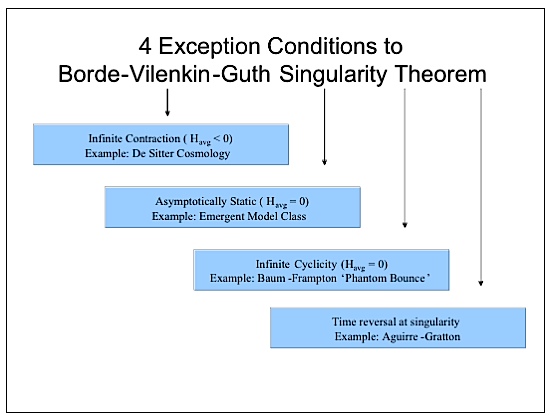
Some current cosmological speculation is based upon attempts to craft models based upon possible exceptions to the Borde-Guth-Vilenkin condition that the universe has on average been in a state of cosmic expansion. In his article Jim provides the following chart of possibilities:

4 exception conditions to Borde-Guth-Vilenkin singularity theorum

The first case involves an infinite contraction prior to the singularity, followed by our current expansion. The second case postulates an unstable initial state followed by an inflationary expansion. The third case imagines a contraction followed by a super-expansion fueled by ‘dark’ energy, with the universe breaking into a multiverse. The fourth case postulates two mirror-image, inflationary expansions, where the arrows of time point away from the cosmological singularity. Jim shows that these highly speculative models are all either in contradiction to observational cosmology or else wind up implying the very beginning of the universe they sought to avert.

The other alternative to the Hawking-Penrose theorems that has been vigorously pursued is Quantum Gravity models. Jim provides the following chart of such models:

quantum gravity classes

The first class of models postulates an eternal vacuum space in which our universe originates via a quantum fluctuation. It was found that these models could not avoid the beginning of the vacuum space itself and so implied the absolute beginning of spacetime. These models did not outlive the early 1980s.

The second class, string theoretical models, have been all the rage lately. They are based upon an alternative to the standard model of particle physics which construes the building blocks of matter to be, not pointlike particles, but one dimensional strings of energy. Jim discusses three types of string cosmological models:

some string cosmologies

The first of these string cosmologies, Ekpyrotic cyclic models, is subject to the Borde-Guth-Vilenkin theorem and so is admitted to involve a beginning of the universe. The second group, Pre-Big Bang models, cannot be extended into the infinite past if they are taken to be realistic descriptions of the universe. The third group, the string landscape models, feature the popular multiverse scenario. They are also subject to the Borde-Guth-Vilenkin theorem and so imply a beginning of the universe. Thus, string cosmological models do not serve to avert the prediction of the standard model that the universe began to exist.

The third class of Quantum Gravity models, Loop Quantum Gravity theories, features versions of a cyclical universe, expanding and contracting. These models do not require an eternal past, and trying to extend them to past infinity is hard to square with the Second Law of Thermodynamics and seems to be ruled out by the accumulation of dark energy, which would in time bring an end to the cycling behavior.

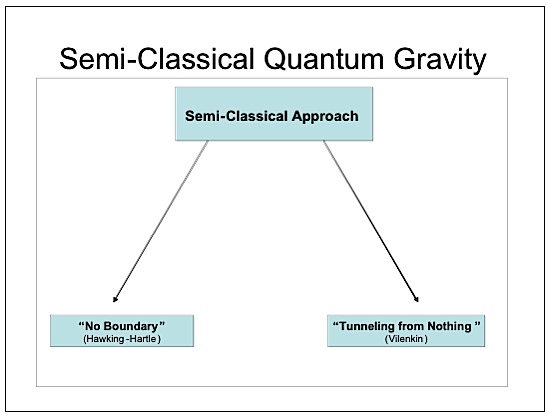
Finally, fourth, the Semi-classical Quantum Gravity models include the famous Hartle-Hawking model and Vilenkin’s own theory:

semi classical quantum gravity

These models feature an absolute beginning of the universe, even if the universe does not come into being at a singular point. Thus, Quantum Gravity models no more avoid the universe’s beginning than do purported Eternal Inflationary models.

In sum, I think you can see how misleading the physicists’ statements to you were. The prediction of the standard model that the universe began to exist remains today as secure as ever—indeed, more secure, in light of the Borde-Guth-Vilenkin theorem and that prediction’s corroboration by the repeated and often imaginative attempts to falsify it. The person who believes that the universe began to exist remains solidly and comfortably within mainstream science.

Tuesday, March 31, 2009

How to Be Led by the Holy Spirit

By R. A. Torrey
Scriptorium Daily

Q: How can one distinguish between the leading of the Holy Spirit and a mere impulse of our own heart?

A. The most important condition of being able to distinguish the true leading of the Holy Spirit is that we be absolutely surrendered to the will of God. There are many people doing the things that they themselves wish to do and calling it the guidance of the Holy Spirit, simply because there has not been a real and absolute surrender of the will to God but afterwards discover that the supposed surrender has not been real.

It is the privilege of every child of God to have the guidance of the Holy Spirit at every turn of life. The conditions upon which that guidance is obtained are clearly stated, or implied, in James 1:5-7, “If any of you lack wisdom, let him ask of God, that giveth to all men liberally, and upbraideth not; and it shall be given him. But let him ask in faith, nothing wavering. For he that wavereth is like a wave of the sea driven with the wind and tossed. For let not that man think that he shall receive anything of the Lord.”

The conditions here stated, or implied are:

First. That the one seeking God’s guidance shall fully realize his own lack of wisdom, i.e., his inability to decide for himself.

Second. That he really desire to know and do the will of God.

Third. That he definitely ask God to show him what to do.

Fourth. That without wavering or doubting he confidently expect God to show him.

Fifth. That he go step by step as the Lord leads.

The one who meets these conditions will be guided. Many of us make the mistake of wishing God to show us the whole way before we take the first step, but God leads a step at a time, and when we take the first step He will make the next step clear.

But if we wait for remote steps to be made clear before we take the first step they will not be made clear. There are many who tell us that they are seeking God’s guidance but can get no light, but when you question them it becomes clear that they have sufficient light for the next step and what they are really seeking is light for a step which they do not have to take as yet. Take the next step that God makes clear before you. You do not need to see beyond that.

Another thing that needs to be said upon the subject of guidance is that God’s guidance is clear guidance. “God is light, and in Him is no darkness at all” (1 John 1:5). Oftentimes when one makes a full surrender to God, the Devil seeks to defeat him by suggesting all manner of difficult or even ridiculous things as the will of God, thus getting him into perplexity and not seldom into spiritual agony. When he does not do these absurd things then the Devil suggests to him that they have not obeyed God, and thus timid souls get into all manner of self-condemnation, and are sometimes even led to doubt their salvation, or to wonder whether they have not committed the unpardonable sin.

When any suggestion as to duty comes to us if our wills are fully surrendered to God and we really are willing to do His will, we have a right to approach our Father as His children without fear (Rom. 8:15) and say, “Father, I wish to do Thy will and will do it if Thou wilt only make it perfectly clear. Now make what Thou dost want me to do as clear as day,” and we have a right to expect that our Father will make it as clear as day if we really desire to do His will. And we are under no obligation to take a step until He does make it as clear as day.

We ought to avoid all undue haste in doing what we imagine to be the will of God just as much as we should avoid delaying when that will is made perfectly clear. “He that believeth shall not make haste” (Isa. 26:16). Many an honest soul in its eagerness to obey God hurries on ahead of God because he does not fully trust God and thus wait for God to make the way perfectly clear. When one does thus hurry on before God he gets into difficulties and oftentimes has to come back and he finds that the thing that he did at great sacrifice he was not called upon to do.

A Christian should live without worry and anxiety (Phil. 4:6). He should not even be anxious lest he may have disobeyed God in some uncertain thing that he thinks perhaps God wanted him to do but concerning which he is not quite sure that God wanted him to do. We are not slaves but children. We have not received the spirit of bondage again to fear, but the spirit of placing as sons whereby we cry, “Abba, Father” (Rom. 8:15).

The life of mental torture and self-condemnation that some conscientious souls suffer for fear they may have disobeyed God in not doing something that it was not at all clear that they should do, is not a life of intelligent faith. We should simply trust God absolutely, surrender to Him absolutely, look to Him to guide us day by day, trust Him to guide us and go on gently and trustfully just as fast as He makes the way perfectly clear, and no faster.

Originally from The King’s Business, “Questions and Answers” by R.A. Torrey, November 1913, pp. 545, 552

Monday, March 30, 2009

Creating Equal

By Louis Markos
Touchstone Magazine

On the Inegalitarian Leadership of Jesus

We hold these truths to be self-evident,” the United States’ Declaration of Independence boldly asserts, “that all men are created equal.” This noble sentiment declares unapologetically that all human beings—no matter their age or sex, culture or religion, race or ethnicity, social class or educational achievement—possess intrinsic dignity and worth. Unfortunately, over the last century, America—and even more Western Europe—has increasingly shifted its focus from political liberty to social engineering, from equal protection before the law to sameness mandated by law, from equality to egalitarianism. The focus today is not on equal creation but on creating equality.

This almost obsessive urge to create equality has spread even to the Church herself. The last several decades in America have witnessed many Christians’ slow surrender to egalitarian values and the projection of those values back onto Jesus, the Bible, and church doctrine and discipline.

To be sure, certain facets of the church have at times adopted a partly egalitarian vision. The early Church described in Acts 2:42–47 engaged in a voluntary sharing of goods and properties. Catholic monastic orders, past and present, have lived communally, their members taking vows of poverty. In the centuries since the Reformation, Protestant sects from the Anabaptists to the Amish have, in keeping with the priesthood of all believers (see 1 Pet. 2:4–5), broken down much of the hierarchical structure between clergy and laity.

Still, even the most radical of Protestant sects or the most severe of monastic orders retain high respect for the authority of the Bible and for the moral wisdom of spiritual leaders (abbot, elder, pastor). In the egalitarianism of today, however, the Bible is treated as a malleable text and church doctrines and disciplines subject to constant revision.

Thus, if the phrasing of the Bible stands in the way of an egalitarian view of the sexes, you simply change the phrasing of the Bible—along with hymns, creeds, and prayer books—to fit your gender-neutral vision of church, marriage, and society. Likewise, if you decide that original sin or substitutionary atonement or eternal damnation might “damage” the self-esteem of the more sensitive in the congregation, you simply find new ways to “understand” these cornerstones of biblical doctrine. Or, to come to the defining egalitarian issue of our day: If you think no distinctions should be made between heterosexual and homosexual “lifestyles,” then you simply jettison the Church’s (and humanity’s!) age-old understanding of marriage and human sexuality so as to embrace same-sex “marriage.”

The Heresy of Inclusivism

Note that Christians who insist on the sanction and blessing of same-sex “marriage” are not saying: “Well, society’s changing, and if the Church doesn’t keep up with the change, she will be looked upon as old-fashioned and irrelevant to the concerns of today.” No, they are saying something far more radical and troubling: “ Because we are Christians, we should be in the forefront of those who are currently fighting for gay ‘marriage.’”

How could those who call themselves Christians take such a position? The answer is that many have accepted what I must call, without apology, the heresy of inclusivism. Though rarely stated so baldly, this heresy posits that at the core of Jesus’ life and teachings is a simple, non-negotiable message of absolute love, tolerance, and inclusivism that should determine every aspect of the faith. Any belief or practice that jeopardizes this message is to be rejected, even if it is stated clearly in the Bible, accepted by the historic Church, and believed by nearly all Christians since the founding of the faith. Any statements or doctrines that portray Jesus as exclusivist or intolerant, even if spoken by Jesus himself, must either be rejected or reinterpreted to fit in with his “true” message of inclusivism and tolerance.


Love is to be “expanded”—that is, reduced—to a nonjudgmental attitude that desires only that people find and experience happiness in their own way. But what of that bold, Christ-like love that will do what it must to rescue a friend from a self-destructive lifestyle, that would rather see a family member suffer pain than live in bondage to sin? Well, if by self-destructive lifestyle and sin you mean that he does not recycle his garbage or support affirmative action or that he votes Republican, I guess it would be okay to set him straight in a loving way. But if you mean that a Christian might be impelled by love to disagree with the lifestyle “preferences” of a brother in Christ and help guide him back to the road of biblical morality, then you simply don’t understand Jesus’ message.

Egalitarian or Not?

Well, then, let us boldly ask the question: Was Jesus an egalitarian or not? To the Christian advocate of same-sex “marriage,” the answer is as obvious as the incident that proves it. Didn’t Jesus, just before celebrating the Last Supper, wash his disciples’ feet? And wasn’t foot-washing a task performed by household slaves? Surely in humbling himself like this, Jesus was clearly demonstrating to posterity that the distinctions between teacher and student, master and servant, leader and follower were no longer valid. Surely this was his way of leveling the old hierarchies and ushering in the egalitarian Age of Aquarius.

It was not.

Right before giving the account of the foot-washing, John says the following: “Jesus knew that the Father had put all things under his power, and that he had come from God and was returning to God; so he got up from the meal, took off his outer clothing, and wrapped a towel around his waist” (John 13:3–4). Notice that Jesus performs the humble act of washing his disciples’ feet from a position of strength and authority. He does not do it because he suddenly realizes that he is the same as everyone else and has no right to claim special authority, but because he knows fully and uniquely who he is.

But the real key to the meaning of the passage comes afterward, when Jesus returns to his seat and explains carefully to his disciples the meaning of the action he has just performed:

“Do you understand what I have done for you?” he asked them. “You call me ‘Teacher’ and ‘Lord,’ and rightly so, for that is what I am. Now that I, your Lord and Teacher, have washed your feet, you also should wash one another’s feet. I have set you an example that you should do as I have done for you. I tell you the truth, no servant is greater than his master, nor is a messenger greater than the one who sent him. Now that you know these things, you will be blessed if you do them.” (vv. 12–17)

Had Jesus wanted to announce the tearing down of all distinctions and ranks, this would have been the ideal time to do it. Instead, he pointedly reiterates that servants are not greater than their masters and messengers are not greater than those who sent them. Indeed, he informs the disciples in no uncertain terms that they are absolutely correct to refer to him as Teacher and Lord. He even, two chapters later, exhorts his disciples to remember that “no servant is greater than his master” (15:20).

Jesus’ deliberate retention of social relationships that embody an inequality of power and status is not confined to John’s Gospel; it is also given voice in the synoptic Gospels: “A student is not above his teacher, nor a servant above his master” (Matt. 10:24); “A student is not above his teacher, but everyone who is fully trained will be like his teacher” (Luke 6:40).

A New Type of Leadership

What is Jesus “doing” if he is not abolishing all hierarchy and ushering in a new egalitarian order? He is instituting a new type of leadership, one that loves and serves those over whom it has power and authority. Luke records a saying of Jesus that, like the foot-washing episode in John, balances an endorsement of distinctions with a call to servant leadership:

Jesus said to [his disciples], “The kings of the Gentiles lord it over them; and those who exercise authority over them call themselves Benefactors. But you are not to be like that. Instead, the greatest among you should be like the youngest, and the one who rules like the one who serves. For who is greater, the one who is at the table or the one who serves? Is it not the one who is at the table? But I am among you as one who serves.” (Luke 22:25–27)

Again, the servant is not greater than his master, yet the true Christian master will manifest his authority through service. Once we accept this, we can see how Jesus’ “intolerant” condemnation of sin and his “tolerant” love for the sinner go hand-in-hand. Throughout the Gospels, we see Jesus forgive sins; we never see him condone or endorse the sinful choices and lifestyle that placed the sinner in need of forgiveness. His word to the sinful woman caught in adultery is not “Continue as you are,” but “Go now and leave your life of sin” (John 8:11). The very fact that he forgives her sin is a clear indication that he considers her actions to be sinful.

Christ offers salvation freely to all who repent and follow him, yet he does not cease condemning the Pharisees for their hypocrisy and hardness of heart (Matt. 23). When asked if only a few people are going to be saved, he answers: “Make every effort to enter through the narrow door, because many, I tell you, will try to enter and will not be able to” (Luke 13:24).

The Divine Perspective

No figure in the Bible speaks more about hell and punishment than the meek and loving Jesus; his very presence in a town tends to polarize people. Images of sifting, judging, and separating abound in his parables; indeed, though we are taught in Sunday school that he spoke in parables so that everyone could understand him, Jesus himself says that he spoke in parables so that “those on the outside” would not understand (Mark 4:10–12). “Do not suppose that I have come to bring peace to the earth,” he proclaims. “I did not come to bring peace, but a sword” (Matt. 10:34).

All this is not to say that Jesus is “unfair” or that he is a harsh taskmaster who is unaware that we all struggle under different weights and have different gifts and resources. In the parable of the talents (Matt. 25:14–30), he tells of three servants who are entrusted with five talents, two talents, and one talent respectively. The third, lazy servant buries his talent in the ground and receives both “exclusivist” scorn and “intolerant” condemnation from his master.

But what of the first two? According to the parable, the first makes five more talents, while the second makes only two. We might therefore expect the first servant to be praised more highly than the second. But this, unexpectedly, does not occur. Instead, the master bestows upon both servants the exact same blessing: “Well done, good and faithful servant! You have been faithful with a few things; I will put you in charge of many things. Come and share your master’s happiness.”

God is just and merciful. He judges us not by what we begin with, but by what we do with what we have been given. He pays us the compliment of treating us as unique individuals, and does not seek to press us all into the same mold.

In a magisterial passage from Democracy in America, Alexis de Tocqueville describes the divine perspective of God:

The deity does not regard the human race collectively. He surveys at one glance and severally all the beings of whom mankind is composed; and He discerns in each man the resemblances that assimilate him to all his fellows, and the differences that distinguish him from them.

God is not like those modern humanitarians who love humanity but care little for human beings. To God, each of us has not only a “corporate” value as a member of the human race but also an individual value that distinguishes us from every other human being who has ever lived or will live on this earth. Neither on earth nor in heaven does God desire to collapse that distinctiveness.

For he who created us knows that we are not all equal!

On Not Living Up To Your Promise

By John Mark Reynolds
Scriptorium Daily

Every once in a while I get an email from a friend facing failure. He or she will tell me of sins they have committed or bad things that happened that have taken them from “promising” to “could have been.” A marriage that began with romance has ended in divorce. A grad school career that started with the excitement of the acceptance letter has petered out in mediocrity. A friendship that started in excitement has died in acrimony.

It is bad news when you are, in the words of William Shatner, “never were” instead of “has been.”

How do you go on living when you haven’t lived up to your promise?

This is a question I have faced myself and there is no easy answer to it. It is hard to accept failure, especially when my own faults and sins have scarred me. I know the truth of the old saying, “a bird with a broken pinion never flies as high again.”

And I want to fly.

Of course, one problem is how we judge success. God wants us to become good. Anybody at anytime can start the long slow process to sainthood. There is always room at the top in Heaven and the purgation can start anywhere.

This is true, but hard to believe.

I always said that the most important thing to me was not outside acclaim, but serving God. My failures have given me a chance to see if that is true. Too often we say we want to be just and good, but are most interested in appearing to be just and good.

My failures at least freed me of that error. If I am still here, then I must go on living and give myself to God. He can transform me. I can love those around me, even if they will not love me back the way I wish.

Is it a success to demonstrate God’s amazing grace?

Of course it is, even if that will never get me on the cover of my college alum magazine.

Perhaps more difficult is when our life turns out to be so average. We were honor students, prizewinners, really great. Right? Why then do we look so much like our parents? We don’t quite realize the arrogance and stupidity of such statements and, God love them, our parents are too humble and good to point it out to us.

Frank Capra taught one generation of Americans to value the average and the steady. He reminded us of the greatness of the man or woman who does their simple duty. Sometimes we don’t achieve our goals simply because our goals were foolish.

God needed one steadier citizen, while we wished to be President. God help us, but we are snobs, but worse, stupid in our snobbery. Jesus Christ, King of the Universe, loves us, but that is not enough. We demand treats and prizes and awards. We want everyone to recognize that He is lucky we love him back.

This is silly. Our good education is not wasted if we spend it being decent and virtuous. Our promise has been fulfilled if we do our duty and love our neighbor as we love ourselves. I know this: Torrey Honors will have been a good place if it educated decent men and women or men and women sensible enough to know that they need to become decent when their “cleverness” finally fails them.

No man or woman is a failure who serves God, even if that service begins, like the Thief, as they are dying on a cross. Surely if there was ever man who failed to live up to his promise, it was that thief. He was condemned and dying. His life was a waste. Nobody knew his name, but one Man.

But what a Man!

One Man still cared. One Man reached out to him as both were dying. There was still time to become a citizen of Paradise and what is better than that?

What God has taught me in a life of “never was” is that He is a God of second and even third chances. While I may never fly again, He can teach me to sing. I am a bird with broken pinions, but He is teaching me to sing in the choirs of Heaven.

Nobody still alive is a failure. Nobody still alive is a “never was” or “has been.” We, all of us, have a chance to begin again and see God.

Really.

We think the way back is too long and it might be if our goals are still worldly acclaim, but if we simply turn around, Father is waiting. He is waiting to put a ring on our finger and a robe on our back. He rejects no repentant soul.

He can save sinners such as we are.

Thanks be to God.

Wednesday, March 25, 2009

Following Jesus: What's Wrong and Right About the Imitation of Christ

By Michael S. Horton
Modern Reformation

Sharing his priorities for the next thirty years, best-selling author Richard Foster disclosed his "spiritual formation agenda" in a January 2009 Christianity Today article. Foster observes that there is a lot of interest these days in "social-service projects." "Everyone thinks of changing the world, but where, oh where, are those who think of changing themselves?"

Besides the obsession with world transformation, he complains that an overemphasis on grace in some circles "will not allow for spiritual growth."

Having been saved by grace, these people have become paralyzed by it. To attempt any progress in the spiritual life smacks of "works righteousness" to them. Their liturgies tell them they sin in word, thought, and deed daily, so they conclude that this is their fate until they die. Heaven is their only release from this world of sin and rebellion. Hence, these well-meaning folks will sit in their pews year after year without realizing any movement forward in their life with God....People may genuinely want to be good, but seldom are they prepared to do what it takes to produce the inward life of goodness that can form the soul.
Foster also blames much of the distraction from spiritual growth to "a Christian entertainment industry that is masquerading as worship" and "an overall consumer mentality that simply dominates the American religious scene."

I find much of what Foster says about contemporary spirituality persuasive. It should come as no surprise to a regular reader of this magazine that I would find him spot-on in his worry that the holiness of God has been eclipsed by the ephemeral exuberance of entertainment passing for worship and consumerism packaged as mission and discipleship. I think he's right that there is a kind of "cheap grace" that fulfills the fond dreams of the antinomian who comforts himself with the syllogism: "God likes to forgive, I like to sin: what a great relationship!" Even if we eschew antinomianism, there is a kind of laziness that does not revel equally in the "already" of new life in Christ and the "not yet" of its consummation. There are too many passages in Scripture that call us to go on to maturity, to leave our old life behind, and to strain toward the prize. Many of those passages are found in the same chapters as our favorite verses on the Good News of salvation by grace alone through faith alone in Christ alone. For example, after announcing that we are saved by grace alone-and that even faith is a gift-Paul adds, "For we are God's workmanship created in Christ Jesus for good works, which he predestined us to walk in" (Eph. 1:8-10).

More than Imitation

The Reformers recognized that grace is first and foremost God's favor toward sinners on account of Christ. This "justice" or "righteousness" by which we stand accepted in God's presence is imputed, not infused; declared immediately, not progressively realized. At the same time, they just as strongly affirmed that God's Word does what it says. Everyone whom God declares to be righteous is also progressively sanctified. While remaining sinful, believers now struggle against indwelling sin.

But why? If the full remission of sins and favor with God is the believer's possession through faith alone, and God's grace is greater than our sin, why shouldn't we go on sinning? That is the question Paul knew his teaching on justification would provoke. His answer, in Romans 6, is that the same Good News that announces our justification also announces our death, burial, and resurrection with Christ. Paul does not threaten with the fears of purgatorial fires or worse, but simply declares to those who believe in Christ that he is not only the source of their justification but of their deliverance from sin's all-controlling dominion. They still sin, but never in the same way that they did before. Now they love what they hated and hate what they loved. I am among a dwindling number of exegetes who still believes that Romans 7 focuses on this paradox: only believers struggle with sin, because sin is both an enduring reality (with many setbacks) and yet the believer's enemy.

Nowhere in this lodestar passage for the Christian life does Paul direct our attention to the imitation of Christ. He has already painted too dark (realistic) a picture of human depravity to imagine that the devil, the world, and our sinful hearts could meet their match in our deeper commitment to follow Christ's example. He calls us not simply to imitate Christ but to live out our union with him. But before he speaks an imperative, he announces the indicative of the gospel: Christ's saving work has accomplished far more than we imagined. The Spirit's work of uniting us to Christ makes us not mere imitators but living members of his body. We are incorporated-baptized-into Christ's death, burial, and resurrection.

Jesus said the same thing in John 15. His disciples are not only forgiven; joined to him as the life-giving Vine they become living branches, bearing fruit that will remain. We have no life in ourselves, he tells them. There are no resources for following Jesus, imitating him, becoming his disciple. We are dead branches, cut off, without hope in this world. Only then does Jesus issue his imperatives to love and serve each other as he has loved and served us.

There is a world of difference between having a role model whose example we fall short of ever reproducing and having yourself "killed" and re-created as branches of the Tree of Life. Doing what Jesus did is different from bearing the fruit of Christ's righteous life. In fact, the most important things that Jesus did cannot be duplicated. Because he fulfilled the law in our place, bore our curse, and was raised in glory to take his throne at the Father's right hand, we can have a relationship with him-and with the Father-that is far more intimate than the relationship of a devotee to a guru, a student to a teacher, or a follower to a master.

Following Christ is the consequence, not the alternative to or even means of union with Christ. Even when Scripture calls us to follow Christ's example, the relationship between master and pupil is asymmetrical. For example, Jesus refers to his impending sacrifice for sinners as the model for his followers in Matthew 20:28. It is obvious, however, from the context that Jesus' act of self-sacrifice is unique and unrepeatable. We are not called to die for our neighbors' sins or to bear the wrath of God in their place. When Paul calls us in Philippians 2 to "have the same mind" as Christ in his self-humiliation, he obviously is not calling us to set aside the heavenly glory and power belonging to the second person of the Trinity and to descend to earth-even hell itself-in human flesh. We are not incarnations of God. Nevertheless, we are beneficiaries of his Incarnation, united in body and soul to his glorified flesh.

As George Lindbeck observed (see the "Justification and Atonement" sidebar on page 18), imitation has its place, but not under the category of "gospel." The call to follow Christ and his example is an imperative-the third use of the law directed to Christians rather than to unbelievers. The "imitation-of-Christ" paradigm of spirituality makes Christ's self-sacrifice and humility an analogy for our discipleship. The "union-with-Christ" paradigm makes our love and service an analogy of Christ's inimitable accomplishment.

Calvin offers helpful insights on this point in his comments on Jesus' prayer in John 17. Believers are "sanctified by the truth," which is God's Word (v. 17), "for the word here denotes the doctrine of the Gospel": here Calvin challenges the "fanatics" who imagine a sanctification that comes from an "inner word" apart from the external Word. "And for their sakes I sanctify myself," Jesus prays (v. 19).

By these words he explains more clearly from what source that sanctification flows, which is completed in us by the doctrine of the Gospel. It is because he consecrated himself to the Father that his holiness might come to us; for as the blessing on the firstfruits is spread over the whole harvest, so the Spirit of God cleanses us by the holiness of Christ, and makes us partakers of it. Nor is this done by imputation only, for in that respect he is said to have been made to us righteousness; but he is likewise said to have been made to us sanctification (1 Cor 1:30) because he has, so to speak, presented us to his Father in his own person, that we may be renewed to true holiness by his Spirit. Besides, though this sanctification belongs to the whole life of Christ, yet the highest illustration of it was given in the sacrifice of his death; for then he showed himself to be the true High Priest, by consecrating the temple, the altar, all the vessels, and the people, by the power of his Spirit.
The goal is "that they may be one" (v. 21). Calvin is as much on home ground in discussing the richness of the organic-horticultural metaphors as the legal. While they are distinct, the organic and the legal are two sides of the same covenantal coin.

Paradoxically, it is this very liberation that issues in constant inner struggle, since we belong definitively to the new creation-"the age to come"-with Christ as our firstfruits and the Spirit as the pledge. Yet we still live in "this present evil age" and continue to pretend that we are not those whom God has worded us to be in Christ. By contrast, the struggle of the unregenerate, according to William Ames, is "not the striving of the Spirit against the flesh but that of the flesh fearing flesh inordinately desiring." Ames's statement points up the fact that however useful Aristotelian or Kantian conceptions of "ethics," "virtue," and "duty" may be, the definitive categories for theology are covenantal and eschatological: the tyranny of sin (flesh) and the reign of life in righteousness (the Spirit). Natural ethics and the enabling power of the Spirit in common grace may check immoderate habits, but the Spirit creates a new world through the gospel.

Just as Paul's treatment of justification led logically to the question, "Should we continue in sin in order that grace may abound?" (Rom. 6:1), the Reformation unleashed radical elements that went well beyond the views of the Reformers. Lutheran theologian Gerhard Forde reminds us, "Luther had hardly begun to proclaim the freedom of the Christian before he had to fight against abuse of the term. He did not do this in such a way as to speak about the good works that must be added to faith. Instead, he did so by calling people back to that faith that occurs 'where the Holy Spirit gives people faith in Christ and thus sanctifies them.'" Luther's response at this juncture was precisely Paul's: Though justified through faith alone, this faith "is never alone, but is always accompanied by love and hope," according to the Formula of Concord (Epitome III, 11; cf. Solid Declaration III, 23, 26, 36, 41).

Apart from the imputation of righteousness, sanctification is simply another religious self-improvement program determined by the powers of this age (the flesh) rather than of the age to come (the Spirit). This gospel not only announces our justification, but our participation in the power of Christ's crucifixion and resurrection. Therefore, we cannot look to Christ at the beginning for our justification, and then look away from Christ to our own progress and countless manuals that offer formulas for spiritual and moral ascent when it comes to the Christian life (sanctification). Again Forde is insightful:

In our modern age, influenced by Pietism and the Enlightenment, our thinking is shaped by what is subjective, by the life of faith, by our inner disposition and motivation, by our inward impulses and the way they are shaped. When we think and live along these lines, sanctification is a matter of personal and individual development and orientation. It is true that we also find this approach in Luther. No one emphasized more sharply than he did our personal responsibility....But this approach is secondary. 'The Word of God always comes first. After it follows faith; after faith, love; then love does every good work, for...it is the fulfilling of the law.'
Even in sanctification, "the focus is not upon the saints but upon sanctification, upon the Word of God in all its sacramental forms, and also upon secular institutions that correspond to the second table of the law....Only God is holy, and what he says and speaks and does is holy. This is how God's holiness works, which he does not keep to himself, but communicates by sharing it."

What this means is that we who once were curved in on ourselves, seeing the world but not really seeing it rightly, must be called out of ourselves to be judged as ungodly and then dressed in Christ's righteousness. This is necessary not only for our justification but for our sanctification as well. Our identity is no longer something that we fabricate in our bondage that we mistake for freedom. "To become new men means losing what we now call 'ourselves,'" C. S. Lewis observes. "Out of our selves, into Christ, we must go." "Your real, new self (which is Christ's and also yours, and yours just because it is His) will not come as long as you are looking for it," he adds. "It will come when you are looking for Him." To be in Christ is to be "very much more themselves than they were before." "He invented-as an author invents characters in a novel-all the different people that you and I were intended to be. In that sense our real selves are all waiting for us in Him. It is no good trying to 'be myself' without Him." "To enter heaven," Lewis says, "is to become more human than you ever succeeded in being on earth."

Far from creating a morbid subjectivity and individualism, as is often charged, this view frees us from being curved in on ourselves, fretting over our own souls. In a moving letter to Cardinal Sadoleto, Calvin made much the same point, when he argued that only by being freed of having to love our neighbor in the service of our own salvation are we able to really love them for their own sake. Sanctification is a life not of acquiring but of receiving from the excess of divine joy that then continues to overflow in excess to our neighbor and from our neighbor to us.

Conclusion

I agree with Richard Foster's concern to step away from our daily routines and to be silent before the Lord, to receive his commands and promises, and to pour out our cries, praises, and intercessions to the Father, in the Son, by the Spirit. Many of us coming out of "monastic" evangelicalism may easily overreact, neglecting-even ridiculing-habits of daily Bible reading and prayer that nourish our souls. I think Foster is right that the problem for evangelicalism today is not that it is too monastic, but that it is too worldly. However, Christ has not left us as orphans, to fend for ourselves by finding spiritual directors and our own means of grace. He promises to work in us by his Spirit through preaching and sacrament.

Paul says in Romans 10 that the message of the gospel ("the righteousness that is by faith") has its own method: Christ himself descending to deliver the Good News through his ambassadors and to unite us to him through faith in his gospel. The imitation paradigm easily slips into "the righteousness that is by works," offering agendas for ascending to heaven to bring God down or descend into the depths as if to bring Christ up from the dead. But Christ is not dead. Nor must he be pulled down from his throne in order to be present in our lives. Paul says that he is present objectively through his Word and Spirit.

When it comes to his methods, Foster's advice is consistent with his message. Where Scripture teaches that Christ's objective work outside of us in public history is the gospel-"the power of God for salvation"-Foster writes,

The most important, most real, most lasting work, is accomplished in the depths of our heart. This work is solitary and interior. It cannot be seen by anyone, not even ourselves. It is a work known only to God. It is the work of heart purity, of soul conversion, of inward transformation, of life formation....Much intense formation work is necessary before we can stand the fires of heaven. Much training is necessary before we are the kind of persons who can safely and easily reign with God.
It would be a travesty simply to lump together medieval mysticism, the Anabaptist tradition, Quakers, Pietism, and Protestant liberalism. Nevertheless, there is a common thread running through these diverse movements-a theology of works-righteousness that emphasizes:
  • Christ's example over his unique and sufficient achievement;
  • The inner experience and piety of believers over the external work and Word of Christ;
  • Our moral transformation over the Spirit's application of redemption;
  • Private soul formation over the public ministry of the means of grace.

When we reverse the priority of these emphases, however, we experience more profoundly the delight of our inheritance, grow in our faith and gratitude toward God and our love toward our neighbors, are constantly renewed inwardly, and take from our public assembly enough morsels to feed on in our family and personal prayers and meditations throughout the week.

We do not need more spiritual directors, but more pastors who feed us, elders who guide us, and deacons who care for the flock's material welfare. Realizing more and more what it means to be living branches, we need more and more to put to death the actual deeds of unrighteousness and live more and more to the Father, in the Son, by the Spirit.

Baptized into Christ, fed richly by his Word and at his Table, let us not leave the festive day forgetful of God's service to us, but be led back each day into his Word and into the world with joyful hearts to be conformed to Christ's image as we work, play, raise children, steward earthly resources, enjoy dinner with friends, and breaks with coworkers. Don't feed off of your New Year's resolutions; rather, feed off of your union with Christ. You are part of the harvest of which the glorified Christ is already the firstfruits! Then resolve again, every day, to return to Christ, to recall your baptism, and to repent of all that weighs you down and distracts you from running the race with your eyes fixed on Christ.